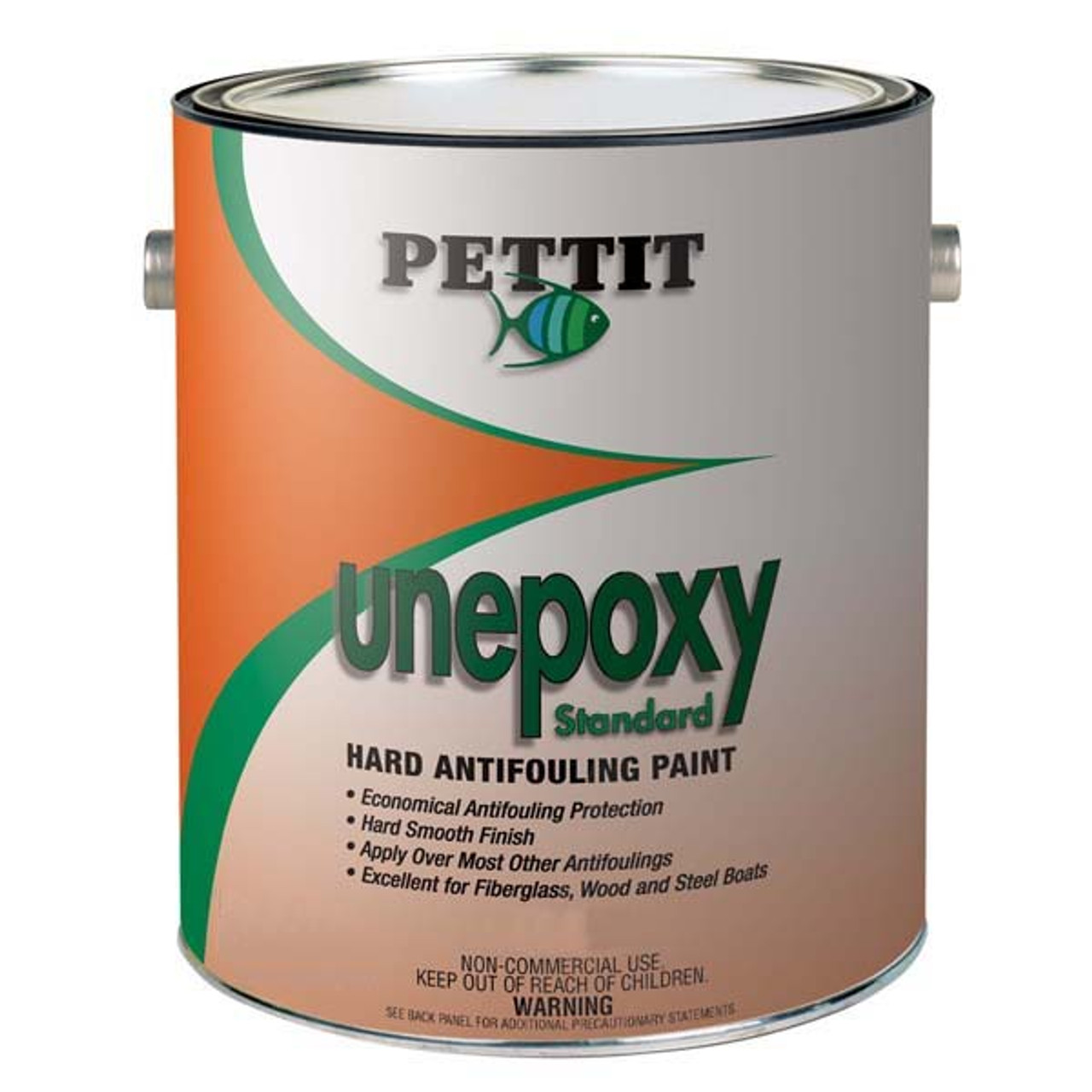
Unepoxy Standard has long been the standard bottom paint for many boatyards and boat owners. It is a dependable antifouling paint formulated to provide outstanding protection at a very affordable price. Its durable, hard modified epoxy finish is able to withstand beaching, trailering, and season-long abuse. It provides excellent coverage and adhesion, and can be applied over most bottom paints in good condition. Suitable for all non-aluminum trailered boats.
Hard Antifouling paints are easily burnished for a smooth racing finish. Hard Antifouling paints have durable paint films that withstand beaching and abuse. When your boat is left in the water, antifouling paints provide long-term protection.
- Application Method: Brush, Roller, Airless or Conventional Spray
- Number of Coats: 2
- Dry Film Thickness per Coat: 2 mils (3.6 wet mils)
- Coverage: 440 sq. ft/gal.
- Application Temp: 40°F Min. / 90°F Max.
- Thinner: 120 Brushing Thinner
DRY TIMES:
| Temp |
To Recoat |
To Launch |
| 90°F |
2 HR |
8 HR |
| 70°F |
4 HR |
16 HR |
| 50°F |
6 HR |
24 HR |
*The above dry times are minimums. Unepoxy Antifouling may be recoated after the minimum time shown and launched up to 60 days after painting.
PREVIOUSLY PAINTED SURFACES: If the previous coating is in good condition, thoroughly sand with 80 grit paper then solvent clean with 120 Brushing Thinner to remove residue. Apply two finish coats of Unepoxy. If the previous coating is soft or in poor condition, remove to the bare surface by sanding or using Pettit 9051 Bio Blast Paint Remover. Proceed with appropriate bare system as described below. Old tin copolymers should be removed or sealed with Pettit 6627 Tie Coat Primer before applying Unepoxy Antifouling.
BARE FIBERGLASS: All bare fiberglass, regardless of age, should be thoroughly cleaned with 92 Bio-Blue Hull Surface Prep or de-waxed several times with Pettit D-95 Dewaxer. Sand thoroughly with 80 grit sandpaper to a dull, frosty finish and rewash the sanded surface with 120 Brushing Thinner to remove sanding residue. Then apply two or three coats of Unepoxy, following application instructions. Careful observation of the above instructions will help ensure long term adhesion of this and subsequent years’ antifouling paint. To eliminate the sanding operation, two methods are available: 1. Prep the surface with 92 Bio-Blue Hull Surface Prep or wash the fiberglass three times using Pettit 95 Dewaxer. Then apply one thin coat of Pettit 6998 Skip-Sand Primer or 6999 Sandless Primer. Use a 3/16” or less nap when applying by roller. Consult the primer label for complete application and antifouling top coating instructions. Apply two or three coats of Unepoxy. 2. Clean, de-wax and etch the surface with 92 Bio-Blue Hull Surface Prep using a course Scotch-Brite pad in a swirling motion. Then apply one coat of Pettit 4700/4701 High Build Epoxy Primer. Consult the primer label for complete application and antifouling top coating instructions. Apply two or three coats of Unepoxy.
BARRIER COAT: Fiberglass bottoms potentially can form osmotic blisters within the gelcoat and into the laminate. To render the bottom as water impermeable as possible, prepare the fiberglass surface as mentioned above (sanding method) then apply three coats of Pettit Protect 4700/4701 Gray High Build Epoxy Primer or three coats of Pettit Protect 4100/4101 White High Build Epoxy Primer per label directions. Apply two or three finish coats of Unepoxy.
BLISTERED FIBERGLASS: See Pettit Technical Bulletin TB-1000 Gelcoat Blister Repair and Prevention Specification for detailed instructions.
BARE WOOD: Sand entire surface with 80 grit paper; wash clean with 120 Brushing Thinner. Apply a coat of Unepoxy thinned 25% with 120 Brushing Thinner, allow an overnight dry, lightly sand and wipe clean. Apply two finish coats of Unepoxy.
STEEL HULLS: Sandblast to SSPC-SP 6 ‘Commercial’ blast, blow off residue with clean, compressed air, and immediately apply two coats 4700/4701 following application and recoat instructions. Alternatively, hand sand with 80 grit sandpaper or power hand tool clean, then remove residue with clean compressed air or clean, solvent dampened rags. Immediately apply one coat of Pettit 6980 Rustlok Steel Primer and let dry to a tack free state (usually 30 minutes to 2 hours, dependent on temperature). Then apply two coats of Pettit Protect 4700/4701 High Build Epoxy Primer following application and recoat instructions. Apply two coats of Unepoxy.
KEELS - LEAD: Abrade surface to bright metal; wipe clean using Pettit 120 Brushing Thinner. Apply one thin coat of 6455/044 Metal Primer; allow to dry two hours. Apply one coat of Pettit 6627 Tie Coat Primer then, if fairing is required, apply 7050 EZ-Fair Epoxy Fairing Compound. Follow with an additional coat of 6627 Tie Coat Primer per label directions. Apply two finish coats of Unepoxy.
KEELS - STEEL OR CAST IRON: Abrade surface to bright metal; wipe clean using Pettit 120 Brushing Thinner. Apply one coat of 6980 Rustlok Steel Primer, allowing to dry only 1 - 2 hours prior to over coating. Then, if fairing is required, apply 7050 EZ-Fair Epoxy Fairing Compound followed by one coat of Pettit 6627 Tie Coat Primer. Apply two finish coats of Unepoxy.
DO NOT USE THIS PRODUCT ON ALUMINUM
APPLICATION INFORMATION: Unepoxy contains cuprous oxide. As a result of this there is a tendency for settling to occur, especially if the paint has been on the shelf for several months. It is necessary to thoroughly mix the paint before using. If possible shake the can of paint on a mechanical paint shaker. Before using check the sides and bottom of the can to make sure all the pigment has been mixed in. If mixing is going to be done with a wooden paddle or an electric drill mixer, pour off half of the liquid from the top of the can into another can and then properly mix in any settled pigment; then remix the two parts together thoroughly. Adhere to all application instructions, precautions, conditions and limitations to obtain optimum performance. Refer to individual labels and tech sheets for detailed instructions when using associated products, etc. Do not thin Unepoxy more than 10% (12 ounces per gallon) or inadequate paint film. No antifouling paint can be effective under all conditions of exposure. Man made pollution and natural occurrences can adversely affect antifouling paint performance. Extreme hot and cold water temperatures, silt, dirt, oil, brackish water and even electrolysis can ruin an antifouling paint. Therefore, we strongly suggest that the bottom of the boat be checked regularly to make sure it is clean and that no growth is occurring. Lightly scrub the bottom with a soft brush to remove anything from the antifouling paint surface. Scrubbing is particularly important with boats that are idle for extended periods of time. The coating is most effective when the boat is used periodically.



 WARNING
Cancer and Reproductive Harm -
WARNING
Cancer and Reproductive Harm -

