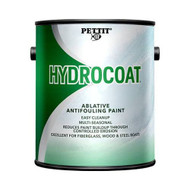
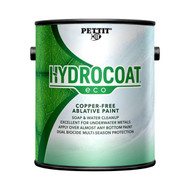
Pettit Hydrocoat Antifouling Bottom Paint
Protect your hull with Pettit Hydrocoat, an eco-friendly, water-based paint that delivers multi-season antifouling protection. This ablative formula wears away gradually, preventing paint buildup while continuously exposing fresh biocide for long-lasting defense against marine growth. Ideal for use in saltwater and freshwater, Hydrocoat bottom paint applies smoothly with easy soap-and-water cleanup. With its low-VOC composition and durable finish, Pettit Hydrocoat is a top choice for boaters seeking reliable antifouling without the harsh solvents. Available in blue or black.
Pettit Hydrocoat is an eco-friendly water-based marine bottom paint that meets all local and state regulations. It is formulated with no harsh smells or solvents. The Pettit Hydrocoat Antifouling Bottom Paint is the industry leader in water-based ablative antifouling paints. It is formulated to be self-polishing and no pre-sanding is required. Pettit Hydrocoat helps protect bottoms from frequent cleaning, bleaching, trailering, and launching that can wear down boat finishes.
Pettit Hydrocoat Antifouling Bottom Paint comes in blue and black color options and is sold by the gallon. Its water-based formula makes it easy to apply with a brush or roller, and clean-up is easy with just soap and water. Use on aluminum hulls or outdrives is not recommended.
Key Features:
- Self-polishing
- 40% Cuprous Oxide
- Copolymer Ablative technology
- PTFE for a slick fast finish
- Multi-season Ablative
- Minimal Odor, Easy Clean-up with Water
- Environmentally friendly
- Comparable to Interlux Micron CSC, and Pettit Horizons
Specifications:
- Type: Water-based ablative
- Recommended Usage: All fouling waters
- Colors Available: 1240 Blue, 1840 Black
- Drying Time: To overcoat 3hrs; To launch; 6hrs. @ 70°F
- Number of Coats Recommended: 2-3
- Coverage: 490 ft2/gal
- VOC: 150 grams/liter
- Biocide: Cuprous Oxide 40.43%
Associated Products:
Pettit Protect Epoxy Primer - Primer for bare fiberglass applications
Pettit 120 Thinner - For surface prep
How Much Pettit Hydrocoat Waterbased Bottom Paint Do I Need for My Boat?
Refer to the chart below to calculate how much Hydrocoat paint you will need for your boat.
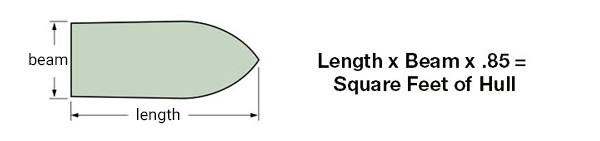
- Calculate the square footage of the hull to be painted - multiply the length of the hull by the beam then multiply that total by .85
- Divide that number (your square foot total) by the amount of coverage Hydrocoat provides. (490 square feet per gallon). This will give you a one-coat total.
Example: If your boat has a length of 28', and a beam of 8.5', you will multiply 28 x 8.5 x .85 to get your total square footage. The total square footage for this boat is 202.3 square feet. A gallon of Hydrocoat has a coverage of 490 square feet per gallon for one coat, so one gallon will be enough for two coats.
How To Apply Pettit Hydrocoat Antifouling Bottom Paint
Pettit Hydrocoat is easily applied using a brush, roller, or sprayer. For rollers, use a high-quality short nap (maximum 3/16" nap) roller cover. Apply using thin coats, as over-application will cause surface imperfections and shorter wear. Before applying, mix the paint thoroughly. Clean and properly prepare surfaces prior to painting. TIP: For the smoothest possible finish: thin the paint 5-10% with clean fresh water. Wet the surface with fresh water. This will provide a truer color and smoother finish.
- Application Methods: Brush, Roller, Airless or Conventional Spray.
- Number of Coats: 2 minimum with an additional coat at the waterline recommended.
- Dry Film Thickness: 1.5 mils (3.75 wet mils)
- Coverage: 490 sq. ft/gal.
- Application Temp: 50°F Min. / 90°F Max.
- Thinner: Clean, fresh water
|
Temp
|
To Touch
|
To Recoat
|
To Launch
|
|
90°F
|
1/4 HR
|
1-1/2 HR
|
6 HR
|
|
70°F
|
1/2 HR
|
3 HR
|
10 HR
|
|
50°F
|
1 HR
|
6 HR
|
16 HR
|
*The above dry times are minimums. Hydrocoat may be recoated after the minimum time shown. There is no maximum dry time before launching.
Application Systems
- Previously Painted Surfaces
- If the previous coating is in good condition, thoroughly sand with 80-grit sandpaper then solvent clean with Pettit 120 Thinner to remove residue.
- Apply two finish coats of Pettit Hydrocoat.
- If the previous coating is soft or in poor condition, remove it to the bare surface by sanding or using paint remover.
- Proceed with an appropriate bare system as described below.
- Old tin or copper copolymers or Teflon-based antifoulings should be sanded thoroughly with 80-grit sandpaper to remove the chalky outer surface.
- Wipe clean of sanding residue, then over-coat directly with Hydrocoat.
- Bare Fiberglass
- All fiberglass, regardless of age, should be thoroughly cleaned with Pettit 92 Bio-Blue Hull Surface Prep or de-waxed several times with Pettit D95 Dewaxer. Proceed with either the sanding method or the non-sanding method:
- Sanding Method:
- After the surface has been dewaxed, sand thoroughly with 80-grit paper to a dull, frosty finish.
- Rewash the surface with Pettit 120 Thinner to remove residue.
- Apply two coats of Pettit Hydrocoat Antifouling Bottom Paint.
- Non-Sanding Method:
- Thoroughly clean, de-wax, and etch the surface with Pettit 92 Bio-Blue Hull Surface Prep using a medium Scotch-Brite pad in a swirling motion.
- Rinse all residue from the surface and let dry. Make sure the entire surface has a dull, frosty finish.
- Wipe the surface to remove any excess moisture.
- Apply two thin coats of Pettit Hydrocoat.
- Barrier Coats
- To render the bottom as water impermeable as possible, prepare the fiberglass surface as mentioned above (sanding method).
- Apply two or three coats of Pettit Protect High Built Epoxy Primer per label directions.
- Apply two thin coats of Pettit Hydrocoat.
- Bare Wood
- Bare wooden hulls should be sanded thoroughly with 80-grit sandpaper.
- Wipe clean of sanding residue with Pettit 120 Thinner.
- A coat of Pettit 6627 Tie-Coat Primer thinned 25% with Pettit 97 Epoxy Thinner should be applied directly to the bare wood.
- Allow to dry for four hours.
- Apply two thin coats of Pettit Hydrocoat.
- Previously Painted Wood
- Thoroughly sand with 80-grit sandpaper.
- If priming is necessary on bare wood spots, apply a touch-up coat of Pettit 6627 Tie-Coat Primer thinned 25% with Pettit Epoxy Thinner.
- Apply two thin coats of Pettit Hydrocoat.
Application Tips
- Hydrocoat does not require sanding between coats.
- Slight variations in color and surface texture are not uncommon and will not affect performance.
- When spraying, do not thin Pettit Hydrocoat more than 10%, or inadequate paint film thickness will occur.
- Burnishing the surface to create a slicker finish should be done with 400-600 grit wet-or-dry sandpaper after the coating has dried for seven days.
- Do not use this product on aluminum hulls and outdrives.
 Click to Download Pettit Hydrocoat Bottom Paint Application Instructions
Frequently Asked Questions
What kind of protection does Pettit Hydrocoat provide?
Pettit Hydrocoat is a water-based ablative antifouling bottom paint designed to provide multi-season protection against marine growth. Its self-polishing formula helps prevent paint build-up while continuously exposing fresh biocide for long-lasting performance.
Is Pettit Hydrocoat easy to clean up after application?
Yes. Pettit Hydrocoat is a water-based formula with minimal odor and easy clean-up using soap and water. It can be applied by brush, roller, airless spray, or conventional spray.
Can Pettit Hydrocoat be used on aluminum hulls or outdrives?
No. Pettit Hydrocoat should not be used on aluminum hulls or outdrives.
How much coverage does Pettit Hydrocoat provide?
Pettit Hydrocoat provides approximately 490 square feet of coverage per gallon. Actual coverage can vary depending on hull size, surface condition, and the number of coats applied.
How many coats of Pettit Hydrocoat should be applied?
Pettit recommends a minimum of 2 coats with an additional coat at the waterline. Always follow the full surface preparation and application instructions for the substrate you are coating.
California Residents:  WARNING
Cancer and Reproductive Harm -
P65Warnings.ca.gov
WARNING
Cancer and Reproductive Harm -
P65Warnings.ca.gov