
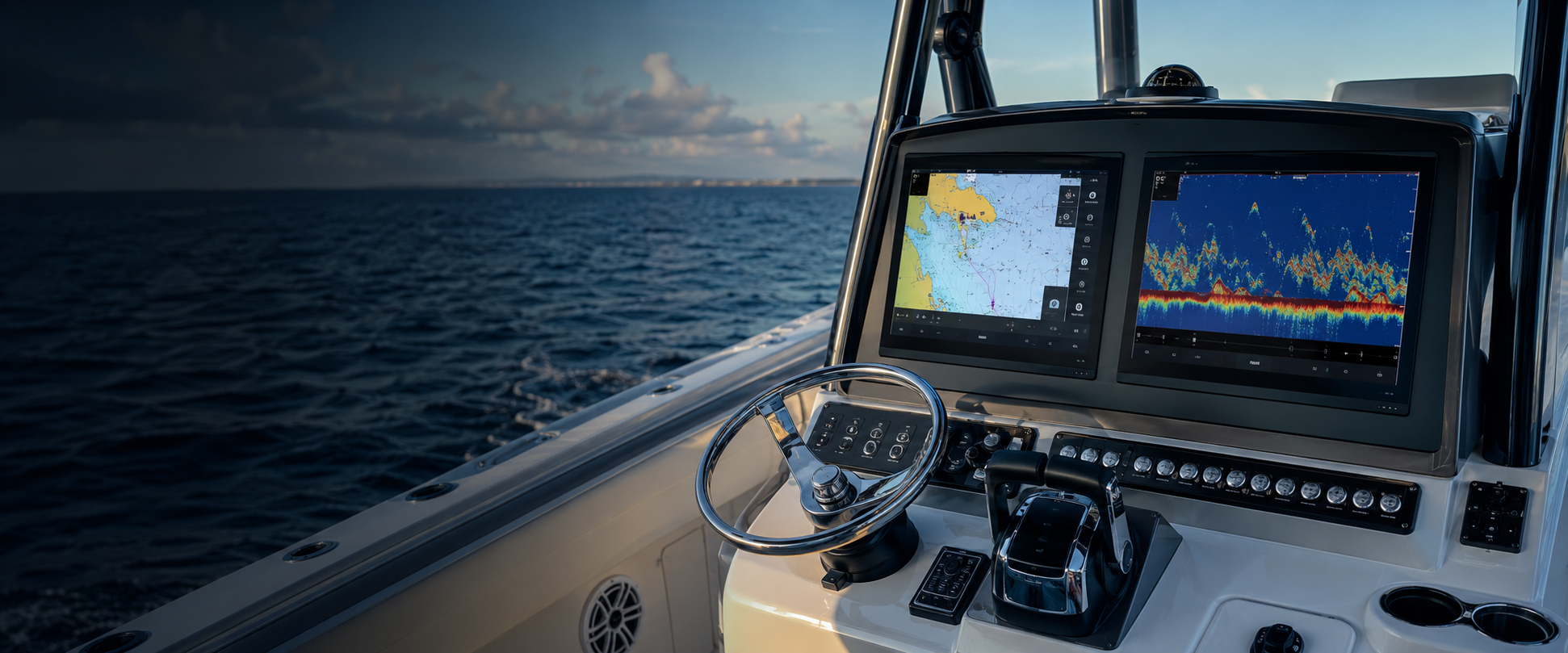
Garmin Marine Electronics for Navigation and Fishing
Garmin marine electronics help boaters navigate, locate fish, monitor underwater conditions, and connect compatible equipment at the helm. The Garmin STRIKER, ECHOMAP, and GPSMAP families support different levels of sonar, mapping, networking, and vessel integration.
The right system depends on how you use your boat, the waters you navigate, the sonar views you need, and whether the display will operate independently or as part of a larger marine network.
Shop Garmin Marine Electronics by Series
Garmin STRIKER units provide approachable fishfinding, sonar, and waypoint-marking capabilities for anglers who want useful information without building a complete networked navigation system.
Garmin ECHOMAP models combine chartplotting and fishfinding features for boaters who want detailed mapping, advanced sonar options, and greater flexibility when selecting a transducer.
Garmin GPSMAP multifunction displays support advanced navigation, sonar, radar, vessel monitoring, and network integration for larger or more sophisticated marine-electronics systems.
Garmin STRIKER vs. ECHOMAP vs. GPSMAP
Garmin STRIKER is a strong starting point for anglers who primarily need fishfinding sonar and the ability to save productive fishing locations. These units are generally suited to straightforward installations where full chartplotting and extensive networking are not the main priorities.
Garmin ECHOMAP adds more complete navigation and mapping capabilities while supporting a wider range of compatible sonar technologies. It is often a practical choice for fishing boats that need chartplotting and detailed sonar in one display.
Garmin GPSMAP is intended for boaters building a more advanced helm. Depending on the model and connected equipment, a GPSMAP display may integrate navigation charts, sonar, radar, cameras, vessel data, autopilot controls, and other compatible networked systems.
Choosing the Right Garmin Display Size
Display size affects both visibility and installation requirements. A larger screen can make it easier to view charts and sonar simultaneously, but it also requires more helm space and may have different power, mounting, and networking requirements.
Measure the available mounting area before ordering. Account for the complete display dimensions, mounting bracket or flush-mount cutout, cable connections, ventilation, viewing angle, and clearance behind the console.
If you frequently use split-screen views, a larger display may make chart, sonar, and vessel information easier to interpret. Smaller displays can be a better fit for compact consoles or boats where space and storage are limited.
Garmin Sonar and Fishfinder Technologies
Traditional sonar provides a view beneath the boat that can help identify depth, bottom structure, vegetation, and possible fish targets. CHIRP sonar transmits across a range of frequencies to improve target separation and provide more detailed returns when used with compatible equipment.
Garmin ClearVü provides a detailed view beneath the boat, while SideVü extends imaging to the sides. Available sonar views vary by display and transducer, so both components must support the desired technology.
Some advanced Garmin systems can support additional sonar capabilities through compatible transducers, sonar modules, or network connections. Review the display specifications before selecting the rest of the system.
Matching a Garmin Display and Transducer
A Garmin display and transducer must be compatible with each other. Check the supported sonar technology, connector style, frequency range, power rating, mounting method, and hull application before purchasing.
Transom-mount transducers are common on smaller powerboats and are generally easier to install. Thru-hull, in-hull, and trolling-motor installations may be better suited to other hull designs or performance requirements.
Do not assume that every Garmin package includes a transducer. Some units are sold as display-only configurations, while others include a particular transducer. Review the individual product listing and included components before ordering.
Garmin Mapping and Navigation
Mapping capabilities vary across Garmin product families and individual models. Consider the waterways you use, the chart coverage included with the unit, and whether optional chart upgrades are available for your region.
A fishfinder with GPS waypoint marking is not necessarily the same as a full chartplotter. If detailed navigation charts, routes, depth contours, or coastal information are important, verify that the selected model supports the required mapping features.
Garmin Marine Networking and System Planning
Before building a networked helm, identify every component you plan to connect. Depending on the equipment, communication may use NMEA 2000, NMEA 0183, Garmin Marine Network connections, or another model-specific interface.
Confirm port availability and determine whether the installation requires backbone components, network cables, adapters, power isolators, sonar modules, or expansion equipment. Similar-looking Garmin displays can have different networking capabilities.
A complete system plan can help prevent incompatible purchases and make it easier to route power, transducer, antenna, and data cables before installation begins.
Garmin Marine Electronics FAQs
What is the difference between Garmin STRIKER and ECHOMAP?
Garmin STRIKER units focus primarily on fishfinding sonar and waypoint marking. Garmin ECHOMAP models add more complete chartplotting and mapping capabilities while supporting a broader selection of compatible sonar options.
When should I choose Garmin GPSMAP?
Consider GPSMAP when building an advanced helm that may integrate navigation, sonar, radar, vessel data, cameras, autopilot controls, or other compatible networked equipment.
Does every Garmin fishfinder include a transducer?
No. Some Garmin units are sold with a transducer, while others are display-only packages. Check the product listing and included-components information before ordering.
Can I use any Garmin transducer with my Garmin display?
No. The display must support the transducer’s connector, sonar technology, frequency range, and power requirements. Verify compatibility for the exact display and transducer models.
What is the difference between ClearVü and SideVü?
ClearVü provides detailed sonar imaging beneath the boat, while SideVü shows structure and targets extending to both sides. The display and transducer must support the selected sonar view.
How do I choose the right screen size?
Measure the helm and consider your normal viewing distance and preferred screen layout. Larger displays make split-screen information easier to view, while smaller displays may fit compact consoles more effectively.
Can Garmin marine displays connect to other onboard electronics?
Many Garmin displays can connect to compatible marine equipment, but networking capabilities vary by series and model. Confirm the required ports, protocols, cables, and network components before purchasing.
Can a Garmin fishfinder be used for navigation?
Some fishfinders can save GPS waypoints but may not provide full chartplotting. Choose an ECHOMAP or GPSMAP model when detailed navigation charts and route-planning capabilities are required.