
CE Smith Boat-Trailer Parts and Accessories
CE Smith manufactures guide-ons, bunk components, rollers, hubs, brackets, and other hardware for maintaining and upgrading boat trailers. These components can help support the hull, guide the boat during loading, and keep frequently serviced trailer systems operating properly.
Trailer parts are not universally interchangeable. Before ordering, measure the existing component and trailer frame, identify the mounting arrangement, and compare dimensions, capacity, materials, and included hardware with the product listing.
Shop CE Smith Trailer Products by Type
Shop post, bunk-board, and roller-style guide-ons for assisting with boat alignment during loading.
Find bunk boards, carpeting, brackets, and related components for supporting compatible boat hulls on a trailer.
Browse bow, keel, and supporting rollers for compatible trailer brackets and hull-contact locations.
Shop hubs, brackets, fasteners, winch components, tie-down equipment, and other trailer service parts.
CE Smith Boat-Trailer Guide-Ons
Guide-ons help indicate trailer position and assist with keeping a boat aligned while loading. The correct style depends on the boat, hull shape, trailer configuration, ramp conditions, and available mounting space.
Measure the trailer frame and determine where the mounting brackets can be installed without interfering with bunks, rollers, fenders, lights, suspension, or the boat hull. Confirm the supported frame dimensions and included hardware for the specific guide-on kit.
CE Smith Post-Style Trailer Guide-Ons
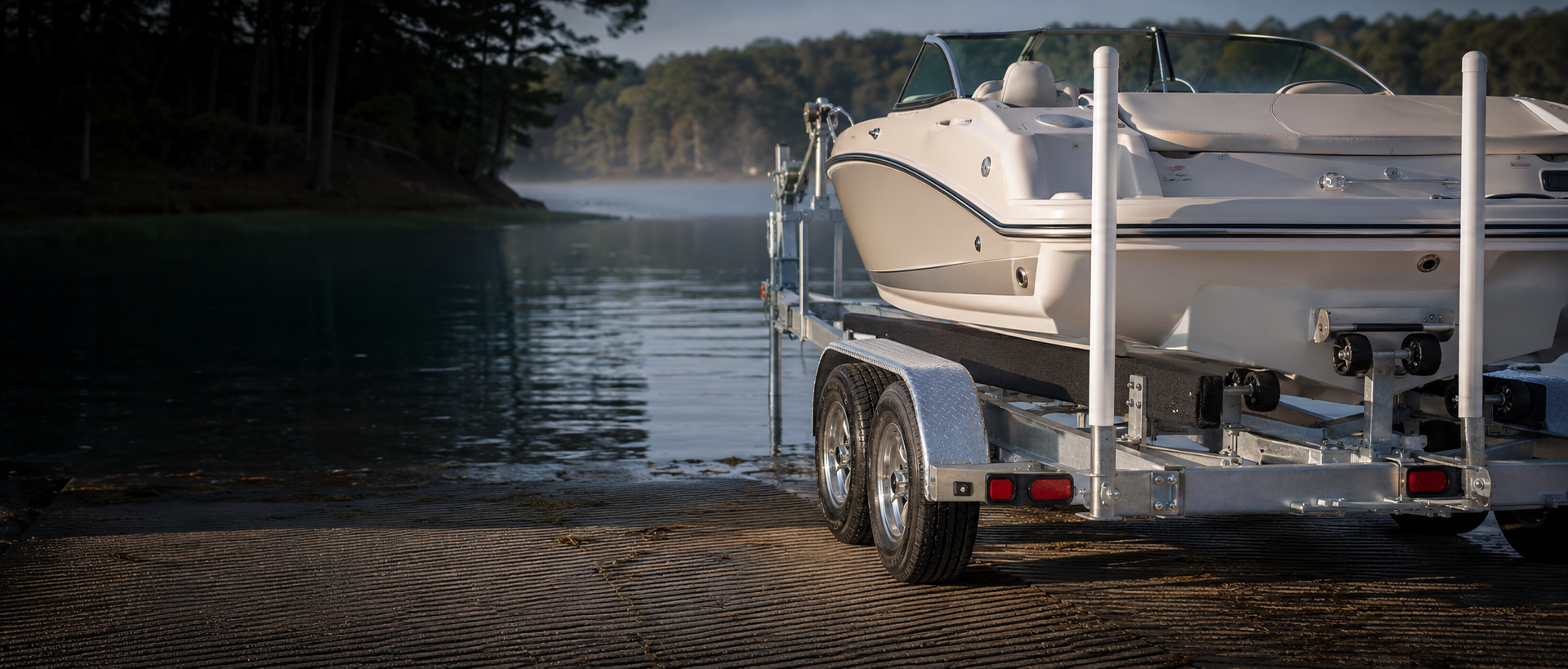
Tall post-style guides help make the rear of a partially submerged trailer easier to see while assisting with boat alignment during loading.
CE Smith Bunk-Board-Style Boat Guide-Ons
Carpeted bunk-style guide-ons provide a longer contact surface for assisting with compatible hull alignment during retrieval.
CE Smith Pontoon Roller-Style Trailer Guide-Ons
Roller-style guide-ons designed for compatible pontoon-trailer configurations. Verify trailer-frame dimensions, roller position, and pontoon clearance before installation.
Shop All Boat-Trailer Guide-Ons
Choosing the Right Trailer Guide-Ons
Post-style guide-ons provide a visible reference when the trailer is partly submerged. Bunk-board guide-ons create a longer carpeted contact area, while roller-style guides use rotating contact points to help position compatible hulls or pontoons.
Guide-ons should be adjusted close enough to assist with alignment without creating excessive pressure against the hull. Check clearance through the boat’s complete loading and unloading path, and inspect the guides after installation to ensure that the brackets and fasteners remain secure.
Guide-ons assist with positioning but do not secure a boat for towing. Always use the trailer winch, bow safety chain, and properly rated transom tie-downs before leaving the ramp.
CE Smith Trailer Bunks and Bunk Carpet
Trailer bunks distribute hull weight across supported contact areas. Worn carpet, exposed fasteners, damaged boards, loose brackets, or incorrect bunk alignment can mark the hull or reduce proper support.
When replacing bunk carpet, measure the complete board length, width, thickness, and the amount of material required to wrap the top, sides, and ends. Inspect the underlying boards and mounting hardware before installing new carpet.
CE Smith Boat-Trailer Bunk-Board Carpet
Replacement carpet for covering compatible boat-trailer bunk boards. Measure the boards and required wrap before choosing a carpet size.
Shop Boat-Trailer Bunks and Components
CE Smith Bow and Keel Rollers
Trailer rollers help guide and support the boat at specific locations on a compatible trailer. Roller selection depends on the installation position, bracket width, shaft diameter, roller length, shape, and hull-contact requirements.
A bow roller helps position the bow near the winch stand, while keel rollers support or guide the keel at designated trailer locations. A roller should turn freely on its shaft and should not have deep cracks, flat spots, excessive wear, or exposed hardware that could contact the hull.
CE Smith Deep-V Rubber Keel Roller
A deep-V rubber roller for compatible keel-guiding and supporting locations. Match the roller length, shaft opening, and bracket arrangement.
A rubber bow roller for compatible winch-stand and bow-stop arrangements. Confirm width, shaft size, and bow-contact position before replacement.
CE Smith Trailer Hub Assemblies
A trailer hub assembly must match the spindle, bearings, seal surface, wheel bolt pattern, wheel size, axle capacity, and intended trailer application. Bolt pattern alone is not enough to identify a compatible hub.
Before replacement, inspect the spindle for scoring, corrosion, heat damage, or wear. Confirm the inner and outer bearing numbers and seal dimensions whenever possible. Bearings should be lubricated, adjusted, and serviced according to the trailer and hub instructions.
CE Smith Boat-Trailer Wheel Hub Assembly Kit
A replacement hub-assembly kit for compatible boat-trailer axles and wheels. Verify spindle, bearing, seal, bolt-pattern, and capacity requirements.
Inspecting Your Boat Trailer Before Towing
Inspect the trailer before each trip. Check tire condition and pressure, wheel fasteners, hubs, bearings, lights, coupler, safety chains, winch strap, bow safety chain, transom tie-downs, bunks, rollers, guide-ons, and visible mounting hardware.
Replace damaged or heavily corroded components with properly rated parts. After installing new guide-ons, rollers, bunks, or hubs, verify clearances and fastener security before towing the boat at road speed.
Rinse trailer components after saltwater exposure when practical and follow the trailer manufacturer’s maintenance schedule for bearings, brakes, tires, and structural components.
CE Smith Trailer Parts FAQs
What do boat-trailer guide-ons do?
Guide-ons provide a visible reference and help keep a boat aligned while it is being loaded. They do not secure the boat to the trailer for towing.
Which type of trailer guide-on should I choose?
Choose according to the boat, hull or pontoon design, trailer frame, loading conditions, and available mounting space. Post, bunk-board, and roller-style guides provide different contact and visibility characteristics.
Will CE Smith guide-ons fit every boat trailer?
No. Measure the trailer frame and check bracket fit, available mounting space, boat clearance, and the supported frame dimensions listed for the specific kit.
Do CE Smith guide-ons include mounting hardware?
Included hardware varies by product. Review the individual listing and compare the supplied brackets and fasteners with the trailer frame before installation.
How do I choose the correct trailer roller?
Match the roller type, length, shape, shaft opening, bracket width, and hull-contact location. Use the existing roller and bracket measurements as identification references.
When should boat-trailer bunk carpet be replaced?
Replace bunk carpet when it is torn, severely worn, loose, or no longer protects the hull from the board and fasteners. Inspect the board and brackets at the same time.
How do I identify the correct trailer hub?
Confirm the spindle dimensions, inner and outer bearing numbers, grease-seal dimensions, wheel bolt pattern, wheel size, and axle capacity. Do not select a hub using bolt pattern alone.
Do guide-ons hold the boat on the trailer while towing?
No. Secure the boat with the trailer winch, bow safety chain, and properly rated transom tie-downs. Guide-ons are alignment aids rather than towing restraints.