
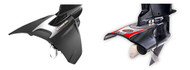
A boat hydrofoil is a performance accessory that mounts to the anti-ventilation plate of an outboard motor or sterndrive. It creates additional stern lift as water flows across it, which may help a boat transition onto plane more quickly, reduce excessive bow rise, maintain plane at a lower speed, and control certain cases of porpoising.
A hydrofoil can be a relatively simple and affordable performance upgrade, but results vary. Boat design, engine height, propeller selection, weight distribution, trim settings, and the hydrofoil’s size and installation all affect how the boat responds.
This guide explains how outboard hydrofoils work, their potential benefits and drawbacks, how to choose one, and when trim tabs or another setup change may be more appropriate.
What Is a Boat Hydrofoil?
In recreational powerboat terminology, a hydrofoil—also called a stabilizer fin or whale tail—is a wing-shaped attachment installed above the propeller on an outboard motor or sterndrive. It is normally mounted to the anti-ventilation plate, which is often informally called the cavitation plate.
This accessory should not be confused with a true hydrofoiling boat. A true hydrofoil uses underwater wings to lift most or all of the hull above the water. An outboard hydrofoil does not lift the entire boat clear of the surface. Instead, it modifies the lift and trim forces acting near the stern.
| Hydrofoil Type | Where It Is Installed | What It Does |
|---|---|---|
| Outboard or sterndrive hydrofoil | On the drive’s anti-ventilation plate | Adds stern lift and changes planing behavior |
| True hydrofoiling system | Beneath the hull on struts or a foil assembly | Lifts most or all of the hull above the water |
Anti-Ventilation Plate vs. Cavitation Plate
The horizontal plate above an outboard or sterndrive propeller is commonly called a cavitation plate, but its more accurate name is the anti-ventilation plate. Its primary purpose is to help prevent surface air from being drawn into the propeller.
Ventilation occurs when air reaches the propeller and causes it to lose its grip on the water. Cavitation is different: it involves vapor bubbles forming and collapsing because of localized pressure changes. Although the terms are often used interchangeably, a hydrofoil does not automatically correct either condition.
Because a hydrofoil mounts to this plate, the plate must be intact and large enough for the selected model. Confirm compatibility before drilling or attaching any hardware.
How Does an Outboard Hydrofoil Work?
As the boat moves forward, water flows around the hydrofoil. The foil’s shape and angle redirect that flow and create an upward force near the stern. This added stern lift can help lower the bow and reduce the amount of time the hull spends pushing through the water before reaching plane.
The amount of lift changes with speed. At low displacement speeds, the foil produces relatively little force. As water speed across the foil increases, lift becomes more noticeable. Once the boat is on plane, the hydrofoil continues to affect trim and handling.
This is why a hydrofoil may help a boat:
- Rise onto plane more quickly
- Experience less bow rise during acceleration
- Stay on plane at a lower speed
- Feel more stable during certain low- and mid-speed maneuvers
- Reduce some types of porpoising
A hydrofoil does not create free power. The accessory also creates drag, and the balance between added lift and added drag determines whether overall performance improves.
Potential Benefits of a Boat Hydrofoil
Quicker planing
One of the most common reasons to install a hydrofoil is to improve hole shot—the boat’s acceleration from rest onto plane. Added stern lift may help the hull transition through the bow-high phase more quickly, particularly when the boat is carrying passengers, gear, or watersports equipment.
Reduced bow rise
Some boats raise the bow significantly during acceleration, temporarily reducing the operator’s forward visibility. A properly selected hydrofoil may help keep the bow lower as the boat climbs onto plane.
Lower minimum planing speed
A hydrofoil may allow certain boats to remain on plane at a lower speed. This can be helpful in rough water, congested areas, or activities where the operator wants controlled planing without running at higher throttle.
Reduced porpoising
Porpoising is a repeated bow-up and bow-down motion that occurs while the boat is on plane. Additional stern lift may reduce porpoising when it is caused by a trim imbalance or insufficient support at the stern.
Porpoising can also result from excessive trim, incorrect engine height, poor weight distribution, hull damage, or an unsuitable propeller. A hydrofoil should not be used to conceal a serious setup or hull problem.
Improved low- and mid-speed control
Some boats feel more planted in turns and experience less bow wandering after a hydrofoil is installed. Results depend on the hull, engine, hydrofoil design, mounting height, and operating conditions.
Possible fuel-economy improvement
If the hydrofoil allows the boat to reach plane sooner or hold plane at a lower throttle setting, fuel use may improve during those operating conditions. However, the foil also adds drag. Fuel savings are not guaranteed and should be measured at comparable loads, speeds, trim settings, and water conditions.
Possible Hydrofoil Drawbacks
A hydrofoil is not the right solution for every boat. Consider the potential disadvantages before installing one.
- Added drag: A foil running deeply in the water may reduce efficiency or top speed.
- Handling changes: Steering effort, trim response, and cornering behavior may change.
- Excessive stern lift: Too much lift can push the bow lower than desired at speed or in following seas.
- Stress on the mounting plate: The anti-ventilation plate carries the load created by the foil.
- Permanent holes: Drill-mounted models require correctly positioned holes in the drive.
- Impact exposure: The larger profile may be more vulnerable to contact with debris, docks, trailers, or underwater objects.
- Hidden setup problems: A foil may partially mask an incorrect propeller, poor load distribution, improper motor height, or hull issue.
A hydrofoil that remains heavily submerged at cruising speed may create more drag than intended. Engine mounting height and the position of the anti-ventilation plate relative to the water are important parts of the installation.
Will a Hydrofoil Make a Boat Faster?
Not necessarily. Most outboard hydrofoils are installed to improve acceleration, planing, and low- to mid-speed handling—not to increase top speed.
Some designs are shaped to minimize drag at higher speeds, and a better-running attitude may improve performance on a particular boat. On another boat, the added underwater surface may reduce top speed. Claims about speed should be treated as model- and installation-dependent.
Measure performance before and after installation using the same:
- Passenger and fuel load
- Propeller
- Engine height
- Trim setting
- Water and weather conditions
- Direction of travel
Useful measurements include time to plane, minimum planing speed, engine rpm, GPS speed, fuel consumption, steering feel, and porpoising behavior.
Will a Hydrofoil Stop Porpoising?
A hydrofoil may reduce porpoising by adding stern lift and bringing the bow down, but the underlying cause should still be investigated.
Before installing a foil, check for:
- Too much positive engine trim
- Excessive weight near the stern
- Incorrect engine mounting height
- Damaged or distorted hull surfaces
- Water trapped inside the hull
- An unsuitable or damaged propeller
- Loose or damaged steering and mounting components
If porpoising begins suddenly after the boat previously handled correctly, inspect the boat and propulsion system rather than assuming a hydrofoil is the solution.
Can a Hydrofoil Fix Propeller Ventilation or Cavitation?
A hydrofoil may affect water flow around the drive, but it should not be treated as a universal cure for propeller ventilation or cavitation.
Propeller ventilation may be caused by:
- An engine mounted too high
- A damaged propeller
- An unsuitable propeller design
- Air entering the water flow during turns
- Hull features or fittings disturbing the water ahead of the propeller
Cavitation may result from propeller damage, excessive blade loading, surface irregularities, or an unsuitable propeller. Continuing to operate a propeller with severe cavitation can damage the blade surface.
Diagnose the cause before adding a hydrofoil. A propeller specialist or marine technician may be able to identify a setup problem more accurately.
What Boats Benefit Most From Hydrofoils?
Hydrofoils are commonly considered for small and midsize planing boats powered by outboards or sterndrives. They may be especially helpful when a boat:
- Takes a long time to reach plane
- Experiences excessive bow rise during acceleration
- Needs to remain on plane at a lower speed
- Porpoises despite reasonable trim and weight distribution
- Operates with varying passenger or gear loads
- Is used for tubing, skiing, or other activities requiring frequent acceleration
- Has limited power-trim capability
A hydrofoil is less likely to help a displacement hull that is not designed to plane. It may also provide limited benefit on a boat that already planes quickly and handles well throughout its operating range.
How to Choose the Right Boat Hydrofoil
Do not select a hydrofoil by appearance alone. Check the manufacturer’s compatibility information and installation template for the exact engine or sterndrive.
Engine horsepower
Hydrofoils are commonly divided into horsepower ranges. A foil designed for a small portable outboard may not provide the correct fit or strength for a high-horsepower engine.
Outboard or sterndrive compatibility
Verify whether the product is intended for an outboard, sterndrive, or both. Check the drive shape, anti-ventilation-plate dimensions, and clearance around trim anodes and other components.
Drill-mounted vs. no-drill installation
Traditional hydrofoils are secured through holes drilled in the anti-ventilation plate. No-drill models use clamps, brackets, or existing openings to avoid permanent modification.
| Installation Type | Advantages | Considerations |
|---|---|---|
| Drill-mounted | Direct mechanical attachment and wide product selection | Requires permanent, accurately positioned holes |
| No-drill | Avoids drilling and may be easier to remove | Must be correctly fitted and periodically checked for security |
Amount and type of lift
Some hydrofoils emphasize strong low-speed stern lift, while others are shaped to reduce high-speed drag or provide different lift settings. Match the design to the problem you are trying to solve.
Material and construction
Hydrofoils may be manufactured from molded polymers, composites, or metal. Consider corrosion resistance, stiffness, impact resistance, hardware quality, and compatibility with the drive material.
Browse Wholesale Marine’s selection of boat hydrofoils and compare each model’s horsepower range, mounting method, dimensions, and intended performance characteristics.
How to Install an Outboard Hydrofoil
Installation varies by brand and model. Use the manufacturer’s instructions and template rather than treating the following as a replacement for the product manual.
Before installation
- Disconnect the engine’s starting power as appropriate
- Support and position the drive safely
- Confirm the hydrofoil fits the horsepower and drive
- Inspect the anti-ventilation plate for cracks or previous damage
- Check clearance around the propeller, trim anode, and steering components
- Read the complete installation instructions
Drill-mounted models
- Position and center the hydrofoil according to the supplied template.
- Check all clearances before marking the holes.
- Mark the mounting points carefully.
- Drill only with the bit size and method specified by the manufacturer.
- Remove burrs and protect exposed metal as directed.
- Install the supplied hardware in the correct orientation.
- Tighten the fasteners to the specified torque.
- Verify that the hydrofoil is centered and cannot contact the propeller.
No-drill models
- Assemble the clamps or mounting brackets as directed.
- Position the hydrofoil evenly on the anti-ventilation plate.
- Install any protective pads or isolators included with the kit.
- Tighten the fasteners evenly to the specified torque.
- Confirm that the unit cannot shift or contact moving components.
- Recheck the attachment after the first test run.
Do not install a hydrofoil on a cracked, heavily corroded, bent, or repaired anti-ventilation plate without professional evaluation. The foil creates additional load on that structure.
Testing the Boat After Installation
A hydrofoil changes the way the boat responds to throttle, trim, steering, and turns. Conduct the first test in open water under calm conditions.
- Inspect the hydrofoil and mounting hardware before launching.
- Begin at idle and confirm normal steering movement.
- Accelerate gradually while monitoring bow rise and steering feel.
- Use small trim adjustments until you learn the new response.
- Avoid abrupt high-speed turns during the initial test.
- Check for unusual spray, vibration, ventilation, or pulling.
- Return to the dock and inspect the hydrofoil and mounting plate.
- Retighten hardware only as permitted by the instructions.
Do not assume the boat’s previous trim position is still correct. The added stern lift may require less trim movement to achieve the desired running attitude.
Hydrofoil vs. Trim Tabs
Hydrofoils and trim tabs can both affect planing and running attitude, but they work in different locations and provide different levels of control.
| Factor | Hydrofoil | Trim Tabs |
|---|---|---|
| Mounting location | Outboard or sterndrive | Boat’s transom |
| Adjustment | Usually fixed after installation | May be adjustable while underway |
| Side-to-side correction | Limited | Independent tabs can correct uneven loading |
| Installation | Generally simpler and less expensive | More involved and may require electrical or hydraulic components |
| Best suited for | General stern lift and planing assistance | Active control of bow attitude and side-to-side list |
A hydrofoil can be an economical option for improving a specific planing problem. Trim tabs provide broader, adjustable control and may be the better solution for larger boats, changing loads, uneven passenger placement, or varying sea conditions.
Hydrofoil vs. Jack Plate
A hydrofoil adds lift near the drive. A jack plate changes the outboard’s vertical height and, depending on the plate, its setback from the transom.
A jack plate may be used to:
- Fine-tune engine height
- Improve shallow-water capability
- Adjust propeller water flow
- Change leverage and setback
- Optimize performance for a particular hull and propeller
A hydrofoil and jack plate do not solve the same problem. An engine mounted at the wrong height should be corrected rather than compensated for with a hydrofoil. When both products are used, verify that the hydrofoil remains at the proper operating depth throughout the jack plate’s range.
Other Adjustments to Make Before Installing a Hydrofoil
Boat performance problems often have more than one cause. Before adding an accessory, inspect the basic setup.
- Move unnecessary weight away from the stern
- Distribute passengers and gear evenly
- Verify the outboard mounting height
- Inspect the propeller for damage
- Confirm the propeller pitch and design suit the boat
- Learn the correct use of power trim
- Check the hull for hooks, rockers, damage, or marine growth
- Confirm that the engine reaches its recommended operating rpm range
If the boat is overloaded, underpowered, improperly propped, or mechanically damaged, a hydrofoil is unlikely to correct the underlying problem.
Frequently Asked Questions About Boat Hydrofoils
What does a hydrofoil do for an outboard motor?
An outboard hydrofoil creates additional lift near the stern as water flows across it. This may help the boat reach plane sooner, reduce bow rise, maintain plane at a lower speed, and control some cases of porpoising.
Will a hydrofoil make my boat faster?
Not necessarily. A hydrofoil commonly targets acceleration and planing behavior rather than top speed. Depending on the boat and installation, it may have little effect on top speed or may reduce it because of added drag.
Do boat hydrofoils improve fuel economy?
They may improve fuel economy if quicker planing or a lower planing speed allows the boat to operate more efficiently. Results vary, and the added drag can offset the benefit in other operating conditions.
Will a hydrofoil stop a boat from porpoising?
A hydrofoil may reduce porpoising caused by insufficient stern lift or trim imbalance. It will not correct every cause, such as excessive engine trim, improper motor height, poor weight distribution, hull damage, or an unsuitable propeller.
Do you have to drill holes to install a hydrofoil?
Some hydrofoils require holes in the anti-ventilation plate, while no-drill designs attach with clamps, brackets, or existing openings. Follow the installation method specified for the selected model.
Can a hydrofoil damage an outboard motor?
A compatible hydrofoil installed correctly on an undamaged anti-ventilation plate should function as designed. Incorrect fitment, overtightened hardware, poor drilling, impacts, or installation on a cracked plate can cause damage.
Are trim tabs better than a hydrofoil?
Trim tabs provide adjustable control over bow attitude and can correct side-to-side list, while a hydrofoil is generally a fixed and simpler source of stern lift. The better option depends on the boat, performance problem, budget, and desired level of control.
How do I choose the right hydrofoil?
Match the hydrofoil to the engine horsepower, outboard or sterndrive model, anti-ventilation-plate dimensions, mounting preference, and performance problem. Verify fitment using the manufacturer’s application information.
Is a Hydrofoil Right for Your Boat?
A hydrofoil may be a worthwhile upgrade when a properly maintained and correctly set up boat is slow to plane, experiences excessive bow rise, or needs additional stern lift at low and moderate speeds. It is not a guaranteed source of extra speed, fuel savings, or longer engine life.
Start by identifying the exact performance issue and checking the boat’s load distribution, engine height, trim, hull, and propeller. If a hydrofoil is appropriate, choose a compatible model, install it exactly as directed, and test the boat carefully under controlled conditions.
Shop Wholesale Marine’s selection of boat hydrofoils for outboards and sterndrives across a range of horsepower ratings and installation styles.